How we built enqueue, retry, and dedup in a Go DAG scheduler
· Tech
Dagu is an open-source, local-first workflow orchestrator (YAML DAGs, scheduler, queues, UI). I contribute Go backend + UI to dagucloud/dagu (formerly dagu-org / yohamta). This post covers three problems that show up once “run a DAG” becomes a durable work queue: enqueue routing, capacity-aware retries, and keeping runs reproducible / non-duplicated.
I’m a contributor, not the sole author. Queues in Dagu didn’t start as an OSS feature request — they started as a production need while I worked on INSAT-3DS data ingestion at ISRO: realtime raw-data image processing when a pass lands, plus bulk reprocess of historical chunks. We built and stress-tested the queue inside the org, then pitched it to maintainer @yota-hamada. That path is #690 → #938 → co-authored landing in #940 / b98063d. Links below are my follow-on merged PRs on routing, capacity-aware retry, and reproducibility. Adjacent features (singleton enqueue, cursor pagination, SSE) are later maintainer work and noted as such.
The shape of the problem
A DAG scheduler has to answer:
- Where does this run go? (which queue / priority)
- What happens when it fails? (retry now vs later, under what policy)
- How do we avoid duplicate or drifted runs? (same identity, locked params, capacity honesty)
Naive answers (“just start the process”) break under load: retries bypass capacity, queue config stuck in YAML can’t handle “replay on the low-priority queue,” and any nonzero exit gets treated the same.

Origin: INSAT-3DS ingest at ISRO, then upstream
While working on INSAT-3DS data ingestion at ISRO, we ran Dagu on satellite raw-data image processing: realtime streams when a pass lands, and occasional reprocess jobs that dump a huge historical chunk back through the same DAGs. Capacity is the hard part — too many concurrent runs and the workers melt; too few and the downlink backlog grows.
Before queues existed in Dagu, we bolted on a sidecar microservice: watch how many DAGs are running, and only ingest/start new work when under a limit. That gated starts, but it was a blind spot for everything waiting. Operators couldn’t tell running vs queued vs stuck, reprocess floods looked the same as realtime, and the control loop lived outside the orchestrator — another service to deploy, another source of truth to distrust under load.
So we implemented a real queue inside Dagu in our org, stress-tested it on production traffic (realtime + bulk reprocess), and only then pitched the design to maintainer @yota-hamada.
That production prototype is #690: file-backed queue + running-count stats, a path so dequeued work went straight to running, and DAGQueueLength. It ran with multiple concurrent DAGs in prod; upstream closed the PR as too large to review in one shot — fair for reviewability, painful when you’ve already proven it under satellite load.
The work didn’t die. Issue #938 cites #690 as the initial implementation and absorbed ideas we needed in ops: config toggle to enable/disable queuing, and dequeue so you can cancel work still waiting (critical when a bad reprocess batch is filling the pipe).
Queues landed in main as #940 (b98063d). The commit records the lineage in the open:
Original implementation by Kriyanshi: …/pull/690
Co-authored-by: Kriyanshi Shah
What that change introduced (the foundation everything below builds on):
Queued status (API + scheduler) — waiting work is first-class, not a fake “not started”- CLI
enqueue / dequeue — create a run as Queued, persist it, push/pop via QueueStore
- File-backed
DualQueue — high/low priority item files under a per-DAG queue dir (local-first, no Redis)
- Scheduler queue reader + processor — drain when concurrency allows, with a
ProcStore for live process tracking
- Paths + UI —
queueDir / procDir, Queued chips, workflow actions wired to the new status
Lineage in one line: INSAT-3DS ingest pain at ISRO → in-org implementation + prod stress test → pitch to Yota → co-authored upstream. The rest of this post is what I built on top once queues lived in main: routing overrides (realtime vs reprocess queues), retries that honor capacity, and locks so bulk reprocess runs stay reproducible.
1. Enqueue is a first-class path (not a side door)
Queue override. DAG YAML can declare a default queue, but operators often need this run on a different queue (backfill vs realtime) without editing the file.
Design:
- Persist an optional
Queue on run status at enqueue time
- Resolution order: stored override → DAG YAML
queue → DAG name
dagu enqueue --queue="realtime" data_processor.yaml
PR: #1240 Add Queue Override Support for DAG Enqueue Operations
Enqueue from a spec. API to enqueue a DAG-run from inline YAML (not only a file on disk) — useful for automation that composes runs dynamically.
PR: #1375 New API endpoint for enqueuing a DAGRun from a spec
Operator hygiene. Clear a queue; dequeue must pass the queue name (ProcGroup) or items get lost.
PRs: #1299 clear queue, #1481 include queue name in dequeue
2. Retry must respect the same capacity as enqueue
The bug class: retry ran immediately and skipped global queue capacity.
Symptom: capacity = 3, but after retries you’d see 4 running. UI and scheduler disagreed. “Retry = start again” was wrong once queues existed.
Fix for DAGs on a global queue:
- Mark attempt Queued, stamp queue metadata, trigger type = Retry
- Enqueue at low priority
- Let the queue processor start it when capacity exists
- Step-level retry still runs immediately (processor doesn’t carry step context)
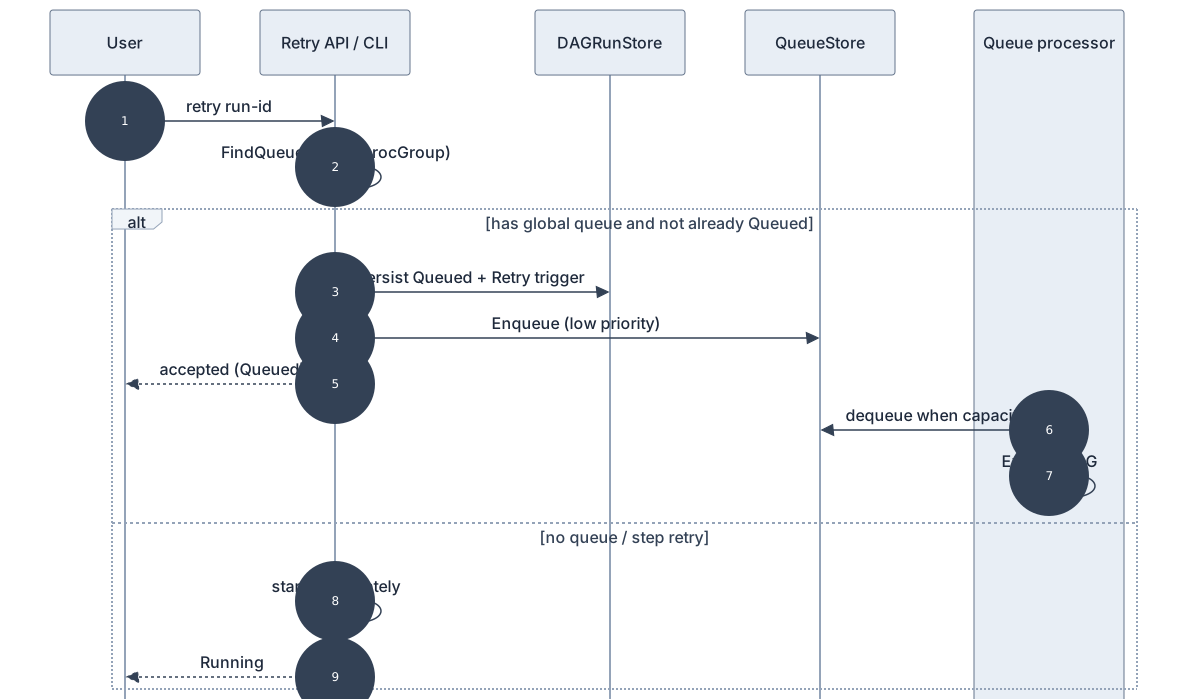
PR: #1676 scheduler: respect global queue capacity on retry
Exit-code-aware step retry. Retries shouldn’t fire on every failure. Step retry_policy can allowlist exit codes — retry on 429/503, fail fast otherwise.
steps:
  - run: curl https://api.example.com/data
    retry_policy:
      limit: 6
      interval_sec: 1
      exit_code: [429, 503]
PR: #902 custom exit codes on retry
Also: disable step-retry controls while the parent DAG is still running (#1447).
3. Dedup and reproducibility
Parameter / run-ID locking. For backfills, science pipelines, and audits, params and run identity shouldn’t drift in the UI mid-flight:
run_config:
  disable_param_edit: true
  disable_run_id_edit: true
PR: #1176 Add DAG configuration to lock parameters and run ID
Attempt identity on enqueue. Enqueue checks for an existing attempt before creating one — same DAG + run ID already exists ⇒ refuse. That store-backed identity is the foundation; opt-in singleton (409 if already running/queued) later landed as maintainer work (#1483) on top of the same problem space. Lesson: check-then-act alone is TOCTOU; real uniqueness needs store semantics.
Status UX (supporting cast)
- Configurable “latest status” window (#558)
- Fix DAG list truncation from a hardcoded paginator cap (#1126)
- Running/failed step names on run summaries for faster triage (#1420)
Cursor pagination and SSE live updates were maintainer follow-ons — they scale the UI without changing the queue/retry core.
Tradeoffs I’d make again
| Choice |
Why |
Cost |
| Retries go through the queue |
Capacity stays honest; UI matches reality |
Slightly higher latency to restart |
| Persist queue override on status |
Routing survives restarts / processor hops |
Extra field + resolution rules |
| Lock params / run ID |
Reproducibility for batch & science |
Less “edit and hot-retry” flexibility |
| Exit-code allowlist on retry |
Fewer useless retries |
Authors must document exit contracts |
| File-backed queues |
Simple local-first ops |
Harder atomic singleton than Redis |
Why this matters for platform / workflow hiring
Same problem space as Temporal task queues, K8s job controllers, and CI runners — and the same shape we hit on INSAT-3DS ingest at ISRO: admit work, bound concurrency, see running vs queued clearly, retries that don’t stampede, reproducible dispatch for bulk reprocess.
My PRs referenced
- #690 original queue implementation (closed; design basis)
- #938 queue feature issue citing #690
- #940 /
b98063d queues land in main (co-authored; credits #690)
- #902 exit-code retry
- #1176 lock parameters + run ID
- #1240 queue override on enqueue
- #1375 enqueue from spec API
- #1676 capacity-aware retry
- #1299 / #1481 queue ops
- #1420 / #1447 status UX
- #1613 production Helm chart (K8s signal)